Article by Riccardo Sozzi
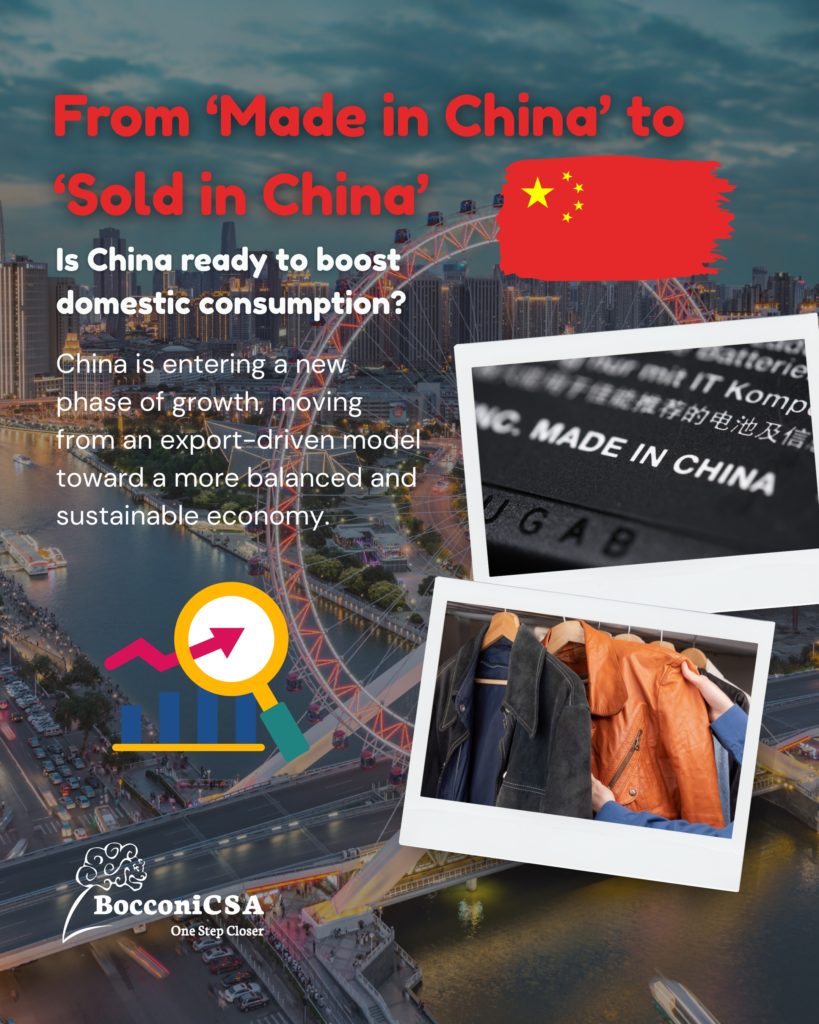
When buying a television, an ornament or a brand-new iPhone we often see the same label on the tag: “Made in China”. It has become a fixture on many consumer products sold in Western countries. In fact, over the last two decades, China has significantly increased its presence in foreign markets: export of goods and services surged from 0.61T to 3.75T USD (current US$)1 between 2004-2024. A large share of these exports is directed to other Asian countries, while the main ex-Asia trading partners are the United States (~14,8%) and the European Union (~15,8%)2.
This expansion is not a coincidence. China has pursued an export-oriented industrialization strategy ever since, in the 1980s, Deng Xiaoping decided to open the country to foreign companies and investors, and subsequent Five-Year Plans have repeatedly stressed the importance of exports. This way, Beijing secured larger selling volumes in developed countries and made effective use of economies of scale.
So far, this strategy has paid off phenomenally: Chinese Gross Domestic Product grew on average by over 8% per year between 2000 and 2024, making the country the world’s second-largest economy. Yet the other side of the coin is that Chinese citizens do not fully benefit from those goods and services as consumers. Although living standards have generally improved, Chinese people tend to save much more money than Western peers, hence spending less. Gross savings in China averaged 42% of GDP in 2023, compared to ~25% in EU5 and ~18% US3. High savings levels come with upsides, especially supporting strategic investments, but they also highlight a structural weakness: when households refrain from spending, domestic demand remains fragile, limiting the country’s ability to rely on its own to secure stable growth in the future. That said, a critical question arises: is this model sustainable in such an unstable geopolitical landscape?
The answer is controversial. Recent tariffs imposed and adjusted (multiple times) by US presidency threatened Chinese export in America; but Beijing seemed to be ready to face the American competitor, as concerns about Chinese expansions have been expressed multiple times in recent year. Similarly, the European Union launched an anti-subsidy investigation into Chinese EV vehicles and in October 2024 imposed definitive tariffs to protect EU car manufacturers.
Given that roughly one third of China’s current exports are directed to Western countries, concerns about the sustainability of the export-led model are increasing.
“Household consumption will be key to sustaining growth amid external and domestic economic challenges,” said Mara Warwick, World Bank Division Director for China, Mongolia, and Korea. “Beyond short-term stimulus, stronger social safety nets, especially for migrant
and temporary workers, would encourage more spending by improving financial security and reducing the need for precautionary saving.”4
Supporting an increase in consumption is no easy task, however. In the short-term, China could leverage some redistribution mechanism, especially for low and middle-income households that are more sensitive to “precautionary saving”. The country still displays substantial heterogeneity in spending power across its population. In the long term, Beijing can rebalance budget outlays from local infrastructure toward people spending. This would involve greater investment in basic pensions, unemployment insurance and healthcare reimbursements.
Additional resources could also be dedicated to supporting a recovery in the real estate sector, which is experiencing severe stagnation. In fact, in the past few years both consumer confidence and real estate sector development have declined across the country5.
In May 2020, the Chinese Communist Party presented a new economic strategy, known as “domestic-international dual circulation”, aimed at making the economy more self-reliant in key sectors and reducing dependence on foreign markets. The 14th Five-Year Plan (2021-25) stressed the necessity to sustain a stronger domestic demand system and, in 2022, the Central Committee and the State Council presented a document (“Outline of the Plan for the Strategy to Expand Domestic Demand 2022-2035”), in which the they explicitly call for ‘expanding residents’ consumption’, strengthening the welfare system and using the domestic market as a key pillar of long-term growth; the latter document, however, does not set any metrics to measure how well the strategy is being implemented6.
China’s shift from “Made in China” to “Sold in China” therefore hinges on whether it can turn its vast domestic market into a more reliable growth engine. External demand is becoming less predictable, as tariff measures by the US and EU expose the vulnerability of an export-dependent model, while high household savings and a weakening property sector weigh on internal demand. In this context, the Chinese government has recently started initiatives to expand domestic demand in line with the “dual circulation” strategy. The impact of these policy measures is not yet clear. Consumption as a share of GDP has recovered to its pre-Covid level, but it has not materially increased7. It is therefore still too early to draw firm conclusions about the effectiveness of the Chinese government’s response.
The coming years will show whether China can adapt its growth model to an increasingly unstable geopolitical environment and replicate the extraordinary growth it has recorded in recent decades.
Sources:
- World Bank Open Data – Exports of goods and services (current US$) – China
- National Bureau of Statistics of China
- World Bank Open Data – Gross savings (% of GDP) 2023, EU5 are: Germany, France, Italy, Spain, Netherlands
- World Bank Group – Unlocking Consumption to Sustain Growth in China – World Bank Economic Update
- National Bureau of Statistics of China and ECB staff calculations (2024) – Consumer confidence and real estate sector developments
- CSET | Center for Security and Emerging Technology (2023) Georgetown University – Outline of the Plan for the Strategy to Expand Domestic Demand (2022-2035)
- World Bank Open Data – Final consumption expenditure (% of GDP – China)
0 Comments